Showing posts with label Blowroom - (Conventional). Show all posts

VERTICAL OPENER OR CRIGHTON OPENER in Blowroom

Object :

To open and clean the cotton.

Type : Major cleaning point & Loose feeding Bladed beater type (Suspended type of feeding by air suction)

Constructional details of the machine is clearly shown in fig.

clip_image092

It consists the inlet pipe into which the tufts are blown by the material transport Fan.

The rapid revolution of the vertical beater shaft, heavier beating of the striker in cotton against grid bar, centrifugal force and gravity combines effectively to open the cotton and remove the heavier major trash particles from it.

Due to opening of cotton tufts, heavy dust, dirt, sand particles, seed bits & other Vegetable particles, short fibres and other foreign impurities are extracted and passed through the spacing of the grid bars, surrounding the beater.

The cotton, tends to rise to the top of the machine, by the following reasons :

Spiral arrangement of the strikers,

Increase in diameter toward the top and so passage of cotton which rotates with increasing surface speed,

The air current at the top of the machine, after opening and cleaning, the cotton is sucked by the subsequent condenser and discharged into the mouth of the pneumatic pipe line (out let) which is connected and feed the materials to the next machine.

Vertical opener is used to process only low grade and short staple cottons.

Due to high degree of opening action and major cleaning point vertical opener is not recommended for processing long stapled fine cottons. In this case, vertical opener is by passed by suitable by-pass arrangement.

The factors affecting the efficiency of this machine are,

i) The beater speed (400 to 900 RPM): Opening action is increased by increasing the speed of the beater.

ii) Setting between beater blade & grid.

Too close setting will tend to curl the cotton and pass too
much good lint through grid bars. If this setting is wider, the
action on the cotton will be less which affect the opening
action. The beater can be raised or lowered to alter the

setting between the striker tips and the grid bars surrounding the beater.

Strength of air current : If too strong - Cotton will raise and pass through too and affect the opening and trash extraction.

If too weak - Cotton will move slowly and will be over treated. This may give good opening but there is a danger of fibre damage and production of curly cotton.

iv) Angle of grid bar : It should be such that the maximum trash

extraction is obtained with minimum lint loss.

If the angle is too wide - There will be loss of good fibre.

If it is too narrow _ cleaning efficiency is affected.

Hence adjustable grid bars have been introduced in latest models, By means of proper adjustment, the optimum angle can be obtained by trial to suit the particular grade of cotton being processed.

v) Space between the grid bars, angle of grid , setting between
beater and grid bar determine the cleaning efficiency of the
machine. A

Read more...

Types of scutcher in Blowroom

Following are 3 types of scutcher

Breaker scutcher

Finisher scutcher 

single process scutcher.

The lap which is produced first is called breaker scutcher lap.

Four breaker laps are placed on lattice of the scutcher line, doubled, and processed again to produce the lap again which is called finisher lap. Because of it, additional cleaning is achieved and regularity of finisher lap is improved.

In modern line, there is only one operation "single process scutcher line"

Modern Beater and electronically controlled feed system and various modernisation in the single process line, reduces both the within and between lap weight variation, and improve the evenness of the lap in single process itself.

So, it is claimed that single process line having the modern beater and electronically feed controller has the following advantages:

Less Floor space; less CV% of lap; Reduced workand worker.
Time saving ; Minimum maintenance; Improved lap uniformity
Reduced power consumption ; Reduced cost of production ;
Increased production rate.

Read more...

TWO-WAY DISTRIBUTOR in Blowroom

Average production of the opening and cleaning line is 700-800  pounds (lbs) per hour. This is approximately twise the production of the scutcher line. So, it is common practice to distribute the cotton from one opening & cleaning line into two or three scutchers. This is achieved by distributors.clip_image042

WHEN HOPPER FEEDER SERVED BY OUTLET 'A' (TO SCUTCHER: 1) IS FULL: Swing door of the reserve bin moves backwards. Micro switch is operated.

Electric circuit energizes the solenoid.

Solenoid holds down the right hand side plunger(Refer fig) This causes the rubber covered roller on the left and rocker bar to make contact and lift the valve door of the cutlet A. the valve door on the outlet 'A' is closed and feeding to the hopper feeder served by outlet A is stopped. Now all the cotton will flow through outlet B which distribute to hopper feeder of scutcher No: 2


SIMILARLY WHEN HOPPER FEEDER SERVED BY OUTLET 'B'
(SCUTCHER; 2) IS FULL:

Solenoid holds down the left hand side plunger and close the

Valve door of the outlet ‘B’

WHEN BOTH OUTLETS ARE CLOSED:

Further circuit is closed, which stop the delivery of cotton from opening line and when hopper reserve bins begins to empty, the circuit is opened and switch on the opening line is automatically operated and feeding recommences.

WHEN BOTH OUTLETS ARE OPENED:

Stock is distributed equally between two hoppers of scutcher

Read more...

Blowroom Scutcher | How it works?

OBJECTS OF THE SCUTCHER ARE:

i) To further break down and clean the cotton tufts by a beater

ii) To convert the mass of cotton fibres into a uniform thick sheet of cotton both longitudinally and transversely and wound in the form of a compactly built lap.

scutcher

MATERIAL PASSAGE IN DOUBLE BEATER SCUTCHER LINE

*TWO WAY DISTRIBUTOR distribute the cotton from opening and
cleaning line of Blow room line into two scutcher equally.

* CONDENSER WITH FAN Suck the material from two way

distributor and feed it to the reserve bin of hopper feeder.

* Hopper feeder ( with Reserve feed & delivery ) mix, comb,

open and clean the cotton. At last it provide uniform feeding of cotton upon the lattice, across the full width of scutcher.

* Pedal feed motion control the feed and maintain the weight

of cotton fed per unit time as constant for lap weight unitormity.

* 3 Bladed Beater Open and clean the cotton.

* Cage with fan Suck the material from Bladed beater,

extract the lighter impurities and it provide uniform feeding as a 3

sheet form on lattice across the full width of the scutcher.

* Again one set of pedal feed motion, 2 Bladed Beater & cage

with fan is placed and above mentioned works areachieved/repeated.

*At last, calender Roller section Compress the sheet ofwhich is delivered from cage.

*Compressed sheet of cotton now pass under the dead roller. and is wound on lap roller, which is called lap.

Read more...

Steps to be taken while changing the length & hank of the lap


clip_image062

Lap Hank= lap length in hanks/weight in lbs.

To change lap hank, the feeding to the sctucher is altered by following methods.

i) feed roller speed is changed by altering the position of the cone drum belt by trial & errer method to bring the required Lap weight & lap hank.

ii) front sheet & back sheet position of the reserve box of the

Hopper feeder & swing door position is altered i.e. weight/unit

length fed to scutcher is altered depending on the required lap hank. For example, to get more wt/ yard of lap front sheet should be moved forward, to increase the volume of the reserve box to get heavier lap.

iii) in automatic scutcher, press button switches are provided for the regulation of the lap weight per yard and lap hank through a servomoter on the P.I.V. drive . The current postion of the PIV drive and the degree of regulation are clearly indicated on a scale. It is possible to determine the optimum

Setting very quickly in case of lap hank change overs. In case of automated scutcher, only the basic lap weight per yard is set by using the corresponding press button switches. All adjusments are automatically carried out by the lap weigher.

Read more...

S.R.R.L opener in Blowroom

Object : To open and clean the cotton clip_image051

Type : Loose feeding saw tooth opener

The cotton is deposited on to the feed lattice. Feed lattice convey the cotton into the bin. Each teeth of each saw toothed cylinder plucks small tuft of fibres from the rotating mass in the bin. Take off cylinder remove the small tuft of cotton from saw toothed cylinder. Take off cylinder convey the cotton over the combing roller.

Combing roller and grid bar extract the trash from cotton. Fast revolving-stripping brush remove the processed lint from takeoff cylinder from which they are sucked by the- subsequent condenser. Also, this brush generates the air stream, which assists in conveying the cotton to the next machine.

one third of the total trash content of the cotton is extracted by this machine.

34 inch wide machine will supply cotton to scutcher, 20" to 3 scutcher & 17" to 2 scutcher respectively.

Principle of this opener:

Momentum is given to a large mass of loosely restrained cotton with in bin and small tuft of fibre is plucked from this mass at a rate avoids breakage or damage to fibres.

Read more...

PORCUPINE OPENER | Working Principle

OBJECT : To open and clean the cotton.

Type : Semi fast controlled feeding bladed beater.

The cotton fed by the previous opener is carried forward by the feed lattice. The sheet of cotton now pass between pedal and pedal roller. The weight of cotton fed per unit time is maintained constant by this pedal feed regulating motion.clip_image001

Pedal roller feed the sheet of cotton in between pair of feed roller which is weighted to give necessary grip on the cotton. 16 circular disc are mounted on the shaft of this opener. 14 to 18 striker blades are rivitted alternatively on each circular disc. Each striker is bent to a slightly different angle.

The compressed sheet of cotton delivered from the feed roller is heavily beated by the rapidly revolving striker of the porcupine beater against grid bar.

Because of this beating action, the cotton is effectively opened and extracted trash particles are passed through the spacing of the grid bar.

At the end of the grid bar, stripping rail is provided, this is a metal bar which is set about 1/16 inch away from the end of the striker. This small clearance between stripping rail and striker prevents bunches of cotton being carried around by the beater.


cotton from the beater region is taken out by the air current set by the fan and is deposited on to the cages.

During the passage of cotton between beater section and cage, it passes over a series of suspended leaf bars where lighter impurities are removed. The compressed sheet of cotton is delivered from the cage by means of pair of delivery roller to the next process. While processing fine cotton and viscose rayon, porcupine opener is not recommended, in this case this opener is by passed by suitable by-pass arrangement provision in this opener.

Setting particulars :

Slightly wider setting is generally used for medium long stapled cotton to avoid fibre damage.

Also wider setting is recommended when a very heavy feed is used, so as not to crush the fibres.

Setting between beater and feed roller = 3/16 inch Setting between beater and first gridbar=3/16 inch Setting between beater and last gridbar = 7/16 inch Setting between beater and stripping rail.=1/16 inch;

Inclination of the grid bars are so arranged that the resistance to the movement of cotton gradual1y decreases, from feeding end to the delivery end.

Setting between grid bar and beater will be gradual1y increased from first grid bar to the last grid in gradual stages.

Wider setting between stripping rail and beater causes unnecessary reprocessing of fibre in the beater section, because of this over treated cotton or repeatedly beated cotton, curely cotton is produced.

Pneumatic Conveyor

Air current setup by the fan with condenser in the blow room line suck the cotton tufts from one machine and transfer or convey to another through pneumatic conveyor and is fed to the next machine by condenser.

Long , curved and 'U-bend' in conveyor pipe line is one of the cause for nep formation in Blow Room.

Read more...

PIANO FEED REGULATING M0TION in Blowroom | How it works?

Object of the pedal feed motion is to maintain the weight of cotton fed to the beater in a scutcher from feed roller as constant per unit time.

clip_image102

The sheet of cotton is fed to the beater of the scutcher through pedal and pedal roller and pair of heavily weighted feed rollers.

16 pedals are provided below the pedal roller.

They are swinging depending upon the thickness of the cotton sheet.

All the pedals are connected to link system and then to the cone drum regulating box as shown in fig.

Bottom cone drum (driving drum) get power from motor. Top cone drum (driven cone drum) drive the feed roller, through worm gear.

Principle:

Due to the thick and thin places of cotton, the movements of pedals are utilised to change the postiion of the belt in the cone drum by means of levers to change the speed the feed roller according to the thick and thin places of cotton in order to keep the feed constant per unit time.

Working of the pedal feed motion:

If thick layer of cotton is going through pedal roller, the speed of the feed roller is reduced and increased in the case of thin layers of cotton is fed in order to keep the feed constant per unit time.

If a thick layer is going through the pedal ( 1 & 2) roller particular ends would be depressed and these pedals are fulcrumed as shown in fig. This causes the ends A,B,C,G,K,N and P will rise (refer fig.) One end of the common lever is fulcrumed and also dead weight is provided on another side.Because of these, the upward movement of the p will depress X and shift the belt on the smaller end of the driving cone drum (bottom cone) and so decreases the speed of the top cone which drive the feed roller slowly.

Similarly if a thin layers passes through the pedal (no. 1 &

2) the ends A,B,C,G,.K,Nand P will fall and end X will rise and
shift the belt on the bigger end of the bottom cone and so
increase the speed of top cone drum, which drive the feed roller
with fast.

If 'A' rises and 'B' falls equally, the point 'C' remains stationary and no change takes place.

If half the pedal ends moves up and other half down, the centre 'N' is not influenced and no change takes place.

If all the pedals rise at once, the whole system of lever and links move bodily upwards except center M, and it all falls if the pedal ends are all depressed.

The feed roller rotates in the same speed without any variation, when average weight of the cotton sheet fed to the beater is same so pedal feed regulating motion helps to produce uniform weight per yard of lap, and we can get even lap hank with low C.V % of metre to metre lap weight variation.

Read more...

OBJECTS OF BLOW ROOM

The Objects of the blow room are :

1. To open the compressed layer of bale of cotton or any staple fibres.

2. To blend different varieties of cotton in the desired proposion to prepare the raw material for the spinning process.

3. To extract the impurities like broken seeds, husks, leaves, sand, stone & iron particles, short fibres, immature fibres, dust, dirt and other foreign materials from the cotton by opening and beating.

4. To convert the mass of cotton fibres in to a uniform thick sheet of cotton both longitudinally and transversely and to wound in the form of compactly built lap.

The object of fibre recovery section of Blow room is recover maximum spinnable fibres from trashy waste obtained from no, blow room, licker-in droppings and flat strips etc.. by special machines in order to reduce the consumption of - virgin n. Provision is made either to mix regenerated fibres with virgin cotton or may be used separately to spin lower counts.

Read more...

Step cleaner in Blowroom | How it works?

step cleaner or ultra cleaner or Gradient cleaner or Giant cleaner:

Type : Loose feeding pin opener

Object : To open & clean the cotton

Feeding section :

Condenser is employed to feed cotton to the step cleaner. Photo-cell arrangement in the reserve tower unit monitor the height of reserve fibre and signals stop or start commands to the proceeding machine. Cotton is fed from the reserve tower by pair of feed roller. According to the height of cotton level, photo cell in the reserve tower of subsequent machine, drive the feed Roller intermittently by motorised gear reduction unit. Beating section :

The rapid revolution of 6 beating cylinders (multiple beater)

and beating of the spikes on cotton against grid bar

centrifugal force and gravity combine effectively to open the cotton and remove the heavier impurities.

clip_image011

Heavier impurities, dust & dirt particles, short fibres, etc, from the cotton are passed through the spacing of the bars and is collected outside the grid bar.

Micro dust Extraction :

Micro dust & fine impurities have deleterious effects on working environment in Textile mill and affect the yarn quality & subsequent processing specially in open end spinning.

Here, dust which is liberated by the action of multiple
beater, is transferred through the perforated screen of the dust
hood and removed by an air stream. Rapidly rotating six

beating cylinder takes the tufts upwards & after opening and cleaning, the cotton from the last beating cylinder is conveyed pneumatically to the next machine through outlet pipe.

SALIENT Features OF STEP CLEANER ARE:

i) Effective Micro dust Extraction by dust hood.

ii) The degree of opening and trash extraction can be adjusted for a very wide range of cotton types and grades by changing the speed of beater, (460,640 and 800 rpm) and the profile of grid to beater.

iii) Action of multiple beater and grid bars Removes heavy impurities iv) maximum trash extraction.

v) Simple efficient unit suitable for all classes of cotton.

vi) Design features facilitate integration with Centralised waste extraction system.

vii) Adjustable grid bar profile to optimise cleaning efficiency.

Read more...

Lap length measuring motion in Blowroom | How it works?

BEQ : why lap length measuring motion is used in blow room Object : i) To stop the rotation of bottom calender roller and feed roller,after a particular length of lap is completed, ii) To measure the lap length and change the lap length as per out requirements by changing the lap length change wheel.

The weight per yard of the lap is based on total weight of the lap, on the assumption that the length of the lap is kept constant. If there is any small variation in the yardage of lap, it is reflected in the total weight and weighing to determine the uniformity of the lap is rendered valueless. If the operator assumes that his measuring motion is accurate and discover that the weight of lap is excessive, he will change the evener motion (feed control system) to secure a lighter lap and meet his standard. However, if the additional weight was due to inaccuracy of the measuring motion and hence to excess yardage, the operative has used the wrong remedy he is now producing a lap which is less than required weight per hard.

clip_image014

Working: figure indicate the position of various parts in this mechanism. As the bottom calender roller rotates the side shaft gets its movement, through the worm and worm wheel connection, and inturn the knock-off wheel (with cam and projection on its surface) is also getting its movement through the change wheel.

A support lever which supports the drop lever is arranged
very close to the knock- off wheel. The drop lever will decide
the position of the drop shaft end wheel which drive the bottom
calender roller. When the knock off wheel rotates the projection and cam on
it slowly press the supporting lever and finally move the
supporting lever away after the complete of 1 rotation of the
knock off wheel. So the drop lever loses its position from
supporting lever and drops down and drop wheel gets disengaged
from the carrier wheel and the bottom calender roller wheel, so
bottem calender roller rotation is stopped.

By means of separate lever connection, the feed roller also stopped by disengaging the clutch unit which drive the feed roller.

After doffing the lap, again the drop lever is kept in position on the supporting lever and thus drive to BCR is engaged and next lap starts to wind on lap roller.

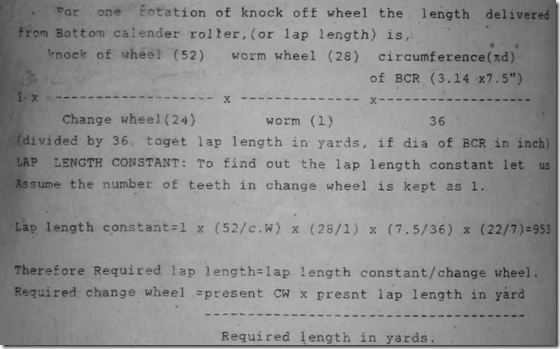
For one rotation of the knock off wheel one lap is completed. To find out the length of lap, we should know the length delivered by a calender roller for one rotation of the knock off wheel. For ex. (Refer gearing diagram)

clip_image0154

In modern scutcher, the required lenghth is preset by means of counter with decimeter settings, the impulse for lap change is given by a limit switch, as soon as the lap attains a definite diameter. Here the length of lap can be easily altered by simply rotating a knob in dial.

Read more...

How LAP HARDENING OR BRAKE MECHANISM in Blowroom Works?

Object : To rotate the lap spindle under tension and get the hardened lap or compact lap.

To stop the machine after one lap is completed and to doff the lap and then restart the machine, lap spindle at both ends are pressed by racks.

All the other constructions are shown in figure.

clip_image013

The brake drum against which a brake pad, fitted with suitable brake lining, is made to press by means of the dead weight, which adjustable.

This Dead weight is carried on weighting lever, pivoted at x and with a high ratio of leverage in exerts considerable upward! pressure on braking lever which has its fulcrum at N and which carries the brake pad.

The forward end of the weighing lever has a foot pedals which when depressed by the operative, releases the braking pressure on the drum and so permits the operative to raise or lower the lap racksfor doffing and restarting.

As the lap increases in diameter, the racks lift, so rotating the pinion and transmitting motion through the gears to the brake drum., which has to turn against the brake action, thus exerting a considerable pressure on the lap through out the whole period of formation of lap.

When depressed by the. operative, releases the breaking pressure on the brake drum and so permits the operative to raise or lower the racks for doffing and restarting.

Read more...

How Laps formed in Blowroom?

The cages uniformely distributes the cotton in uniform sheet form across the width of the machine to calender roller section.

There are four calender roller made off polished cast iron mounted one over the other, are heavily weighted, by a force of to 2 tonnes being applied by means of the lever. The sheet of cotton passes out between top and second calender roller and then leaves between bottom and third calender roller as shown in figure. The surface speed at the nipping point of the two calender roller, will make the lap sheet to give more ironing effect and also a pressing effect. This makes the lap sheet compact.

From bottom calender roller the sheet of cotton passes under the dead or pressure roller which helps to maintain the compact condition of the sheet as it is delivered to the fluted shell rol1ers.

In between two shell rollers, lap roller is placed and this tap roller is rotated by the surface contact of the shell roller.

The worker places the sheet of cotton between lap roller and
shell roller and pressure is applied at both the end of the lap
roller. This initiates the formation of the lap on the lap
roller.

Read more...

KIRSCHNER BEATER : Krishna Beater

Object: 

To comb and extract the lighter impurities from cotton.

kirshnerbeater

Kirschner Beater has 3 arms like 3 Bladed beater but in place of blades there are wooden lag(5.5 inch wide) carrying a large no. of steel pins (24 Rows) and inclined in the direction of rotation and project about 3/8 inch from surface of wooden lag. So, instead of beating ,here combing action is achieved.

The sheet of cotton delivered from feed roll is combed by the revolving steel pins of the beater against the grid across the width of the machine. Lighter impurities are thoroughly extracted from cotton and passed through the grid bars.

For what type of cotton you will prefer Kirschhner beater ?

Due to its minor cleaning action ie extraction of lighter impurities by combing action on cotton, it is cal1ed as miner cleaning point and is best suitable to process long staple & fine cotton. Because i) trash content is less in fine cotton. ii) Severe beating by Major cleaning points are not recommended for fine cotton, because severe beating will increase the neps & damage the fine/long staples of cotton.

Read more...

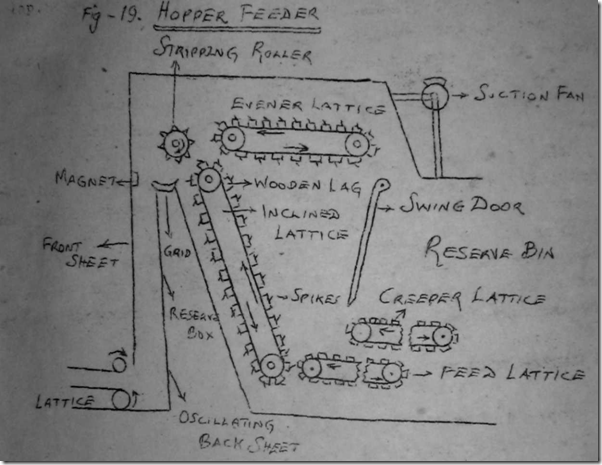
HOPPER FEEDER In Blowroom: How it works

In Hopper Feeder the following objects are achieved :

The material is thoroughly blended in main bin.

The material is combed by the spikes of the inclined lattice.

The cotton is well opened when passes in between evener roller and spiked inclined lattice.

Sand, heavy trashes are extracted through grid bars and iron particles are removed from the cotton by the magnet.

Fan is provided in the top of the machine and sucks the dusty air which is settled down in the cellar.

Also, the principle object of the Hopper Feeder is to provide uniform feeding of cotton on lattice across the full width of the machine.

clip_image012

Because of these specialities, the Hopper Feeder is repeated in the Blow room line

The cotton coming from previous machine is deposited on creeper latticed Reserve bin. Creeper lattice will deliver the cotton on feed Lattice of main bin. Feed lattice will take cotton forward close to the inclined lattice. Swing door is used to maintain the constant level of cotton on feed lattice

Due to the spikes on the inclined lattice and direction of movement, lumps bf cotton will be carried upwards by the inclined lattice.

Hard pressed layers of cotton are well combed by the spikes of inclined lattice.

revolving spikes of the evener roller or lattice beats and open the cotton.

Due to the close space between evener lattice and inclined lattice and rotation of evener roller in a opposite direction, unopened excess lumps of cottons are thrown back into mixing bin.

Stripping roller strip the cotton from inclined lattice and projects it over a grid bar system where sand, heavy trash are passed through the spacing of the grid.

From stripping roller the cotton is deposited, layer by layer in. the reserve box and is taken into next machine by lattice in the form of uniform feeding across the full width of the scutcher.

Importance of feed control in Hopper Feeder:

The volume of cotton contained in the reserve bin determine the regulatity or uniformity of the lap.

Front sheet should be set properly according to the lap weight per yard required.

Improper feeding in the hopper and improper setting of front sheet will tend to produce too heavy or low weight lap (or) non uniformity lap which causes to reject the lap.

So feed control in Hopper Feeder is important in the blow room line to produce uniform lap.

Read more...

GRAVITY TRAPES - Blowroom

The object of the gravity trape is to extract the seeds
stones and other heavy impurities from the cotton. Seeds in

cotton must be removed, if not it causes so many difficulties in
subsequent spinning preparatory process. For Ex, Seeds get
crushed under the calender Roller in Blow Room & expel seed oil
and affect the lap quality.

clip_image010

At carding, metallic wires get loaded with seed coats which affect the carding quality.

The installation of gravity trap at step cleaner is shown in fig.

It can be installed at any point where the material is accelerated by either gravitational or i beating force and where further flow of material takes place by air suction.

Under these condition, if the air inlet to the suction system is provided the delivered material has a tendency to be thrown out of the air inlet, it is possible to effect the seeds and heavy particle against the resistance of incoming air.

Read more...

Dust Extraction in Blow Room line:

During the beating & opening action of machines, large amount of dust is generated. This has to be removed effectively for 2 reason

i)To Safe guard the health of operative.

ii) To reduce, the micro duct in cleaned cotton.

clip_image007

* No. of fans are used in the scutcher carry the cotton from one machine to another.

* The air is heavily charged with dust & short Fibres. * This dust laden air exhausted by the fan is blown into cellar, which is the dust Room under, the scutcher.

* Cellar is necessary to collect the dust which the air Carries. If the fans exhausted directly outside, the Mill yard would be very dusty.

* Leading from the dust room(Cellar) there is a dust chimney Dust Tower) through which the dust air passes from the dust room to out doors.

II. Cellar less Blow Room:

In cellar less Blow Room line Filters are introduced to maintain the atmoshpere free from dust.

* By recirculating the filtered air to the room, it maintain the even temperature and R.H% of the room and reduce the humidification cost. , Further, short fibres are collected as Saleable waste. Recirculating air Filter ( Dust Filter Bag)

This filter receive the dust-ladened air from the fans of scutcher at the top. Air strikes against a buffle and travels downward within the filter case (fig is given in next page).

The sides of the filter are covered with a coarse screen. outside of this screen is a second screen with fine mesh.

clip_image009

Air laden with dust is drawn by the fan from Blow Room via under floor or over head ducting and is then blown into primary filter Rapidlly. Fine screen collects the dust and it built up between fine and coarse screen which form a filter, permitting the filtered pure air to pass out.Dust inside the screen droops into bottom where there is a compartment designed to collect.

clip_image006

Fibrous waste being deposited in a thick blanket on the surface of the drum.

The filtered air with residual dust emerge axialully from the primary filter drum and pass radially into the secondary filter drum, which is covered with thick porous filter medium.

clip_image008

Clean air emerges axially from Second filter drum can returned to the department directly or via the air conditioning system filter unit.

It is a minor cleaning point where the lighter impurities, fine dust and floating fibres are extracted from the cotton by the air current. A No. of dust trunks are provided in series in pneumatice conveyer pipe. During the passage of cotton pneumatically in conveyor duct, the slight resistance of the suspended plate upon the cotton causes the light impurities to deposit/fall under the trunk.

Dust seperation by Grid bar: Dust & other trash particles which are extracted through spacing of the grid bar of Various beaters & falls into the dead air box( under the grid, not in cellar) This droppings & dust has to be collected / cleaned frequently (every] shift).

Read more...

condensing cage: Blowroom

Cages, separate the cotton from the air current which is helping to carry it and then collect and deposit the cotton on cage surface after it has passed from the beater chamber of scutcher, then uniformly distribute the cotton to the Calender Roller section in Uniform sheet form across the width of the scutcher.clip_image005

It is a Cylindrical cage, open at the ends, the surface of which is made of mesh wire. It consists of cast iron wheel around which is built a casing with mesh wire screening or perforated tinned sheets.

The air flow by which cotton is conveyed from the beater to cage is induced by the fan situated beneath the cage and connected to them by air flues from the end of the each cage.

Under ideal condition the air flow to the cage is uniform and constant across the full width of scutcher. The air in oassing through the perforation of the cages deposits, is uniform fleece of cotton on to their surface.

Faulty air current and irregular airflow on cages due to incorrect settings of damper and dust accumulation in air passage, are some causes for high variation in lap weight. Owing to lack of air control and some time dampers choked with dust and dirt in one side. Due to this, faults occur such as the formation of conical lap caused by depositing of more cotton on one side than another.

Another source of trouble is split lap( the sheet of cotton splits) This is due to equal amount of cotton is deposited on each cage, making virtually two separate sheets and they refuse to combine even after being calendered under considerable pressure. To correct this, it is necessary to direct most of the fibres on to the top cage and only a relatively thin sheet of fibres on bottom cage. The flues connecting the cages to the fan housing are equipped with suitable dampers or valves to adjust the air flow to correct above faults. To avoid split lap, single cage is used in modern scutcher.


Barrel shaped laps are due to excessive fan speed.

Strength of the air current from the ends of both cage can be regulated with damper, which may cover the opening as desired, to get the proper current of air to make a uniform distribution of cotton on the cage.

Gage, being connected to the fan, permit the dust ladden air to pass through.the perforations and retain the cleaned lint on their surface which is stripped by the cage delivery roller and it then distribute in sheet form to the calender roller across the width of the scutcher.

Dust laden air exhausted by the fan is blown into a dust settling chamber. Light impurities, fine dust, short fibres are thus extracted by the cage, so it is one of the minor cleaning point

Read more...

Cleaning efficiency of Blowroom - Calculation

clip_image004

Trash% in cotton is estimated by shirley trash Analyser. Cleaning Efficiency, depends on the following factors.

Trash% in feed,

Amount of preopening,

Speed of Beater,

Maturity of Cotton,

Nature of Impurities

Settings, etc.,

Read more...

classification of opening & cleaning machines - Blowroom

All opening & cleaning machines can may be broadly classified following types : Loose feeding and beating technigue-free beating pointed led type of feeding by air suction :

1. Vertical opener ( Bladed beater type)

2. Step cleaner ( Pin opener type)

3. S.R.R.L opener ( Saw tooth opener type)

4. Axi flow cleaner/ spiro cleaner. ( Pin opener type)

5. Mono cylinder ( Pin opener type )

6. Air jet cleaner (Dust extraction from cotton by air force) semi fast gripped and controlled feeding and beating technique :

1. Porcupine opener ( Bladed beater type)

2. 3 or 2 Bladed beater ( Bladed beater type)

3.  Kirschner beater

4. Improved porcupine beater

5. E.R.M cleaner

Major & Minor cleaning points

The machine where heavier trash particles are extracted from cotton by heavier beating action is called Major cleaning Point.

Ex : Vertical opener, Porcupine opener, step cleaner S.R.L.L. Opener, Shirley opener

The Machines where only fine dust & lighter impurities extracted by giving light beating or combing action on cotton by air current is called minor cleaning point.

EX: Kirschner beater, condensing cages, Dust Trunk, Dust filters,

etc.,

Read more...